Variation orders are killing your margins (here's the maths)
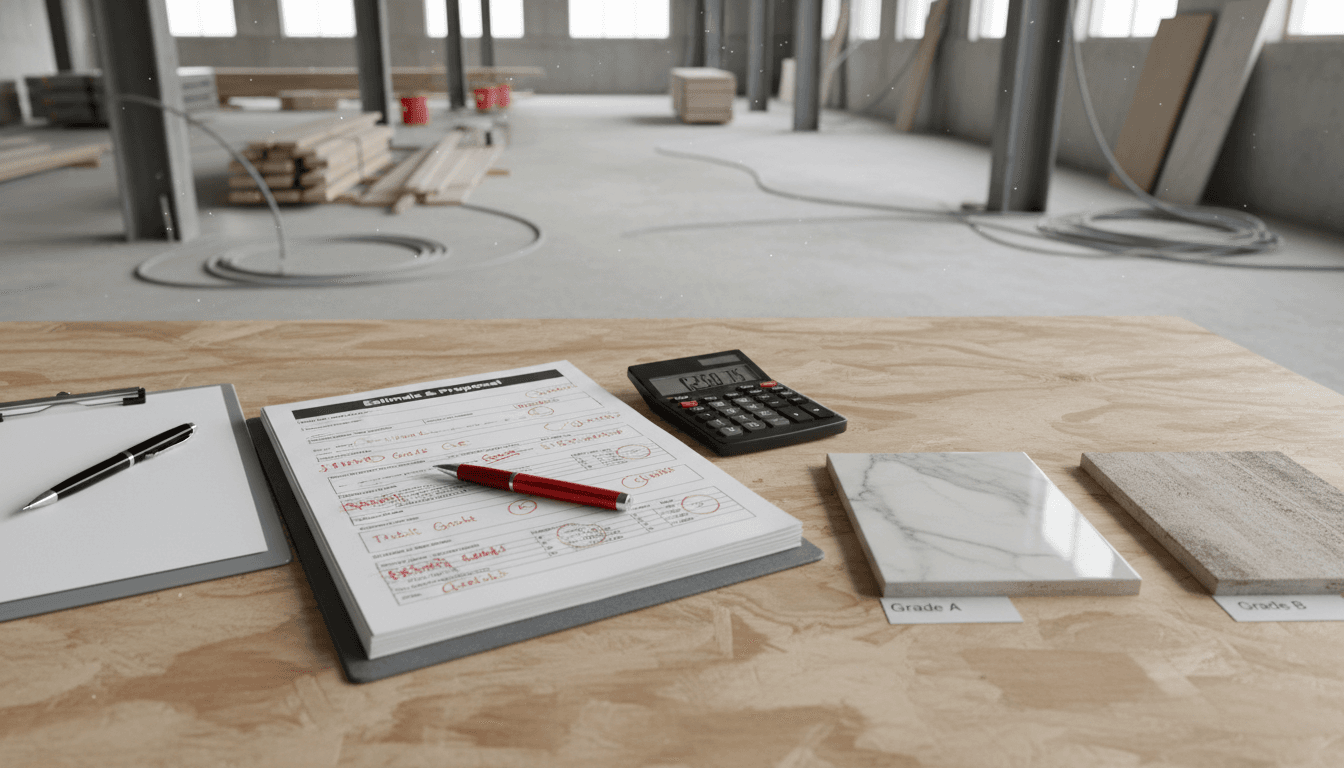
The S$3,200 kitchen countertop that nobody invoiced
Here's a situation that will feel familiar if you run a renovation studio.
You're three weeks into an S$80,000 HDB 4-room renovation. The client walks into the half-finished kitchen, looks at the quartz countertop, and says: "Actually, can we upgrade to sintered stone? My sister-in-law got it and it looks amazing."
Your designer says yes on the spot because the client relationship is good and they don't want to make it awkward. The contractor swaps the material. Nobody writes it down. The project finishes. You invoice the original amount. The S$3,200 difference between quartz and sintered stone? You just ate it.
This is a variation order. Or rather, this is the absence of one. And it happens on nearly every project.
What a variation order actually costs you
Let's do the maths on that S$80,000 HDB renovation. Most studios in Singapore price residential projects at a 25-35% gross margin (RICS Singapore Chapter, Cost Management Report 2024). We'll use 30% because it's a common target for mid-range work.
At 30% margin, your target profit on this project is S$24,000. Your costs should land around S$56,000.
Now the client requests that countertop upgrade. Sintered stone costs S$4,800 installed; the original quartz was S$1,600. That's S$3,200 extra in material and labour costs.
If you don't invoice it:
- Your costs go from S$56,000 to S$59,200
- Your revenue stays at S$80,000
- Your actual margin drops from 30% to 26%
- You've lost S$3,200 in profit, which is 13.3% of your expected margin
That's one change. One countertop. On one project.
Now multiply it. The RICS Global Construction Survey (2024) found that roughly 70% of construction and renovation projects experience at least one scope change during execution. In our experience working with Singapore studios, the number is higher for residential. Clients live in the space while imagining changes. They browse Pinterest. They visit friends' newly renovated flats.
A typical S$80K HDB renovation will have 3-5 scope changes. If each one averages S$2,000-3,000 in additional cost, and even half of those go untracked, you're looking at S$3,000-7,500 in absorbed costs. On a project where your target profit was S$24,000, that's a 12-31% hit to your bottom line.
The five most common VO triggers (and what they actually cost)
We pulled anonymised data from studios using our platform to see where scope changes actually happen. This isn't a scientific sample, but the patterns are consistent enough to be useful.
In Singapore HDB and condo renovations:
- Tile upgrades. The client picks a more expensive tile after seeing the original installed in one area. Typical delta: S$800-2,500 depending on the area size and the gap between materials.
- "Can we add two more power points in the kitchen island?" Electrical additions sneak in because they sound small, but each additional point involves hacking, wiring, and patching. Usually S$150-400 per point, and it adds up when the client wants six extra.
- Carpentry scope changes are the big one. The wardrobe was supposed to be 8 feet, now they want it extended to 10 feet and they'd like soft-close hinges on everything. These run S$1,500-5,000 depending on complexity.
- Then there are feature wall additions. A client decides mid-project they want a fluted panel feature wall in the living room. S$2,000-4,000 for materials and installation.
- Bathroom fixture upgrades. The original rain shower was from a local supplier; now they want Hansgrohe. S$500-2,000 per fixture.
In Dubai villa and apartment renovations:
The triggers are similar but the numbers are different. Material substitutions are the biggest one. A client who approved Italian porcelain tile at AED 120/sqm decides mid-project they want natural marble at AED 350/sqm. On 200 sqm of flooring, that's AED 46,000 (roughly S$17,000) in additional cost.
Design revisions on luxury finishes are the second major trigger. Custom joinery modifications, upgraded lighting fixtures (switching from Flos to Moooi, for example), and changes to wall panelling. These tend to be larger individual amounts because the base specification was already higher.
In both markets, the pattern is the same: the cost of the change is real, but the paperwork doesn't happen.
Why studios don't track VOs (even when they know they should)
Every studio owner we've spoken to understands that untracked changes cost them money. So why does it keep happening?
Three reasons come up over and over.
First, the conversation feels uncomfortable. Telling a client "that change will cost S$3,200 extra" when you're standing in their half-renovated kitchen feels adversarial. The designer doesn't want to sour the relationship. So they say "sure, no problem" and figure they'll sort it out later. Later never comes.
Second, the process is manual and slow. If tracking a VO means opening a laptop, creating a new document, getting the client to sign it, scanning it, and filing it, most designers will skip it. Especially on site. Especially when the next task is already waiting.
Third, there's no system connecting the VO to the invoice. Even when a designer does document a change, it lives in a WhatsApp message or a note on their phone. It doesn't automatically flow into the project's financial record. When the admin team generates the final invoice three months later, that WhatsApp note is buried under 500 other messages.
An internal survey we ran in Q4 2025 across 112 Singapore studios found that fewer than 30% track variation orders digitally. The rest use some combination of WhatsApp messages, handwritten notes, and memory. (Full disclosure: we sell software that does this, so we have every reason to highlight the problem. Take the number with that context.)
What proper VO tracking looks like in practice
The fix isn't complicated. It just needs to be fast enough that designers will actually do it on site.
A good VO workflow has four steps:
- Document the change immediately. The moment a client requests something different from the original scope, it gets recorded. Description of the change, reason, estimated cost impact. This can be a form on a phone. It doesn't need to be a legal document at this stage.
- Next, pull the original line item from the quote, compare it to the new specification, and show the delta. If your quoting system is digital, this takes seconds. If it's in Excel, it takes longer but it's still possible.
- Get client acknowledgment. The client needs to see the cost impact and agree to it before the work happens. A digital signature on a phone screen is fine. What matters is that there's a record.
- Finally, make sure the approved VO flows into the project's financial record so it gets included in the next billing cycle. No manual copying. No "I'll add it later."
The compounding effect works both ways. If you track five VOs on that S$80K project, each averaging S$2,500, you've just recovered S$12,500 in revenue that would have otherwise disappeared. That's more than half your original profit target.
Some studios go further and build a small markup into VOs, typically 10-15% above the cost increase, to account for the disruption and coordination overhead. This is standard practice in commercial construction and there's no reason it shouldn't apply to residential renovation. The key is transparency: tell the client upfront that changes carry a coordination fee.
The margin difference between studios that track and studios that don't
We don't have perfect data on this because most studios don't publish their financials. But we can share directional numbers from studios on our platform.
Studios that track VOs digitally report actual project margins of 26-32%, which is close to their targets. Studios that rely on informal tracking report actual margins of 18-25%, with the gap widest on projects above S$60,000 where scope changes are more frequent and more expensive (Qanvast studio partner data, 2025, anonymised).
The gap is 5-10 percentage points. On a S$80,000 project, that's S$4,000-8,000 in profit. On a studio doing 15-20 projects a year, it's S$60,000-160,000 annually.
That's not a rounding error. That's a designer's salary. That's the difference between a profitable year and a tight one.
None of this requires fancy software, to be clear. A disciplined studio with a good Excel template and a policy of "every change gets documented before work starts" can capture most of the benefit. Digital tools make it faster and harder to forget, but the core habit is what matters.
If you're reading this and thinking "we probably leave money on the table with change orders," you're almost certainly right. The question is how much, and whether that number is big enough to change how your team handles VOs on the next project.